Heinz Bethge Award for Materials Science 2026
point electronic supports the next generation of scientists
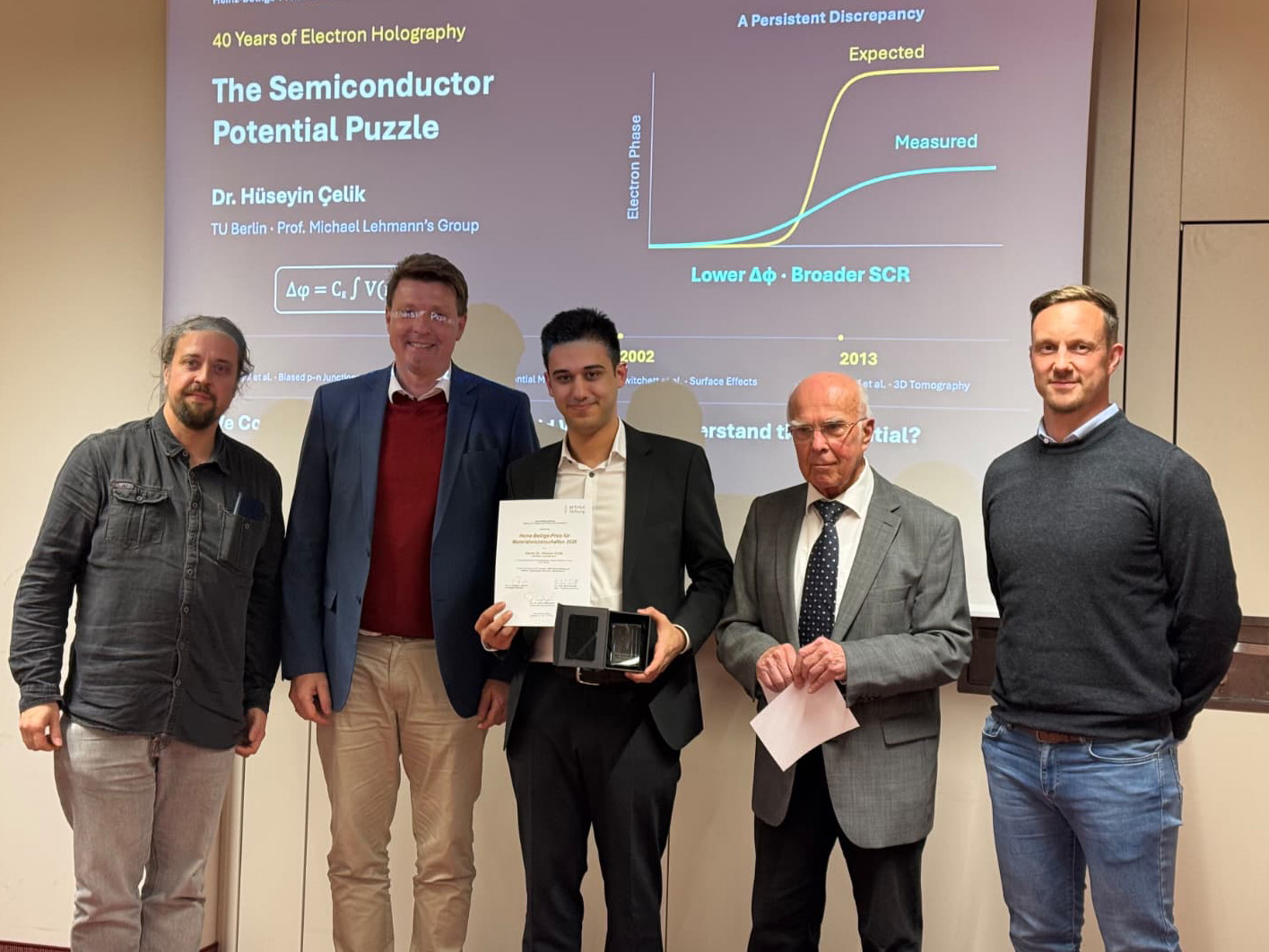
The 2026 Heinz Bethge Award for Materials Science has been presented to Dr. Hüseyin Çelik. In his award-winning doctoral thesis “From 2D Phase to 3D Potential: SIMP-Based Modeling of Electric Landscapes in Electronic Nanodevices”, he addresses a key challenge in quantitative electron holography: Why do semiconductor junctions appear weaker and wider than expected?
Once again this year, point electronic has supported the award by contributing the prize money.
In his research, Hüseyin Çelik developed a novel forward model based on SIMP that accounts for surface effects and enables the reconstruction of the three-dimensional electrostatic potential from a single holographic projection. In addition, he translates this methodology into practical applications for semiconductor nanodevices.
By supporting this award, we at point electronic aim to encourage and promote young talent in the field of electron microscopy, providing early-career scientists with both recognition for their achievements and motivation for their future research.
In addition, we have been actively involved for many years as a member of the Board of Trustees of the Heinz Bethge Foundation. We also support the Foundation's electron microscopy laboratory for school students, helping to introduce the next generation to the fascinating world of electron microscopy.
Thorgund Nemec has been awarded the 2026 Heinz-Bethge Young Scientist Award. Her diploma thesis, carried out at TU Dresden, at the Leibniz Institute for Solid State and Materials Research Dresden (IFW) and at the Dresden Center for Nanoanalysis, demonstrates how functional nanostructured surfaces can be deliberately generated by chemical dealloying of a Cu-Ti-Zr-Ni metallic glass.
We extend our warmest congratulations to both award winners.